Showing posts with label Fitness. Show all posts

Tuesday, April 30, 2013

Post 40: Triphasic Training


          About a month ago, I can't even remember what I was searching for, but came across a review for Triphasic Training by Cal Dietz. I hate to admit it, but I had never even heard of him before. After about 20 minutes of reading the reviews and looking into some articles published to kind of hype up the book I ended up buying it. It was a Sunday night, the book was delivered to my inbox by Monday afternoon and I finished it by Wednesday  It was like seeing a great movie, after I finished the last page of text and looked over all the sample programs and different modifications for the training splits, I just sat there.. And then felt like watching it again. Instead of doing that though, I just went back through all the charts and made my own copies of them on Excel and pinned them up beside my computer. This was going to take some experimenting. 


           Basically, the premise of this book rings back to a heading in Supertraining and that is "All athletic movement is triphasic." That's a pretty strong statement. 

          The shape of the "V" on the front of the book makes more sense after you read it and grasp the foundational concepts. As I mentioned in one of my articles about speed training there was a eccentric, amortization, and concentric phase with each stride. On a more loosely applied but still concrete basis, this is true of everything we do in sport, throwing, running, cutting, jumping etc. 

          Anyone who has read reviews or articles on this concept has seen this picture. The sharper blue "V" is a visual representation of a more powerful, explosive and neurally efficient athlete. In this case, a shot putter performing an explosive rep on the bench press. Basically, what you're seeing is someone who can take a sharp eccentric action and spin it around into a powerful QUICK concentric action. This guy beat the pants off the red line guy on the actual throws. 

          Dietz puts a powerful new spin on block periodization and divides the training schedule into blocks based on different parts of movement (Eccentric, Isometric, Concentric.) He Follows that up with a standard (what everyone else does) "reactive" block and then where appropriate tacks on a fifth block of what he calls the "Antagonistically Facilitated Speed Strength Method" which - in as few words as possible - uses timed sets, drop-offs, and other bio-feedback methods. 

          Honestly, after reading this book, I felt like I'd read 2 books, actually 3. Maybe 4, I don't know. All I know is that this stuff started making a WHOLE lot more sense to me. What in the world was I doing before?! About a week after reading this, I based my own programming on the same model and started experimenting on myself. I loved the results I was feeling. I have also applied the same principles to 4 or 5 athletes whom I work with on a regular basis to prepare them for college, and this has been a very rewarding experience for all of us. If you haven't checked out this book and are serious about getting stronger, faster, and more powerful, you're kidding yourself. Unless you already know everything, which let's be serious - If you think you know everything, you're an idiot. 

Monday, March 18, 2013

Post 39: Sprint Training


          As if anyone cares, I wrote an article back in February of last year on Speed Training. I always find it comforting when I can look back on things that I knew in the past... and realize I've learned since then. Recently I've been reading the eBook from Bret Contreras and Chris Beardsley, The Optimal Athlete: Sprinting. Although not everything I've read so far is exactly news to me, they've done a nice job of selecting studies to review that make more sense of what are sometimes abstract concepts.

          In the beginning, Bret makes a statement regarding the nature of scientific research. If you know anything about Contreras, you know he loves science. I would agree that sometimes it is frustrating to read studies that always end with "more research is needed," but as Bret mentions in the beginning of this review, it is wisest to stick to the common threads throughout the research.

          Since this blog is really more of a place for me to keep all my thoughts and stuff, I'm going to throw down a few things that I found to be of particular interest. Especially relevant to training athletes (most specifically sprinters) for speed. If that helps you great, if not, whatever.


Concept 1: Net horizontal propulsive forces are of greater importance than total ground reactive forces (including vertical.)

          A while back I recall reading an interview in which Bret talks about this French kid Christophe Lemaitre. In the interview, it was discussed that he tested with unusually high horizontally-oriented GRF's (ground reactive forces.)

          For those of you who are not familiar with the terminology, GRF's are the resulting force from the ground to the object in contact with it. For every action there is an equal and opposite reaction, etc. Therefore the GRF is equal to the force applied to the ground, and by virtue of the mechanics, it has a vector too.


          So in order for two things to happen: a) A human to travel forwards, b) A human to continue forward, force must be applied by the support leg both horizontally (to accomplish part a) and vertically to buy time for the trail leg to recover and enter the late swing phase before contact. What is interesting however, is that not only is it important to be able to apply a great deal of force quickly, but that the studies consistently demonstrate greater importance of the amount of force applied horizontally. Vertical GRF's are really only necessary to give the athlete time to prepare the subsequent stride and replace the next step in optimal location on the track. So with this in mind, coupled with specificity, it is recommended by the authors that sprinters use exercises which train strength and power in a more horizontal plane - Like Bret's famous Hip Thrusts.

Concept 2: F-V qualities of muscle are of greater importance than absolute strength.

          The Force-Velocity relationship is basically an illustration demonstrating that we move heavy weights slow and light weights fast. More specifically, different qualities fall on different parts of the force velocity cuve. As their names might suggest, Absolute Strength would fall far to the right, where load is greatest and speed is negligible, and speed-strength would fall high-left where muscle shortening velocity is highest, and load lowest. However, if you note the dotted line (as always) there is an optimal range for power output.
          Think about bench pressing. If you can take 135 pounds and throw it off your chest, doing reps will be fast, but not require a high percentage of your absolute strength. If you can take 300 pounds and move it slowly, you have likely taxed your absolute strength, but have not even begun to approach appreciable velocity. So although different for everyone, there is an optimal range for power output where the force produced and the velocity at which the muscle contracts to do so are in perfect balance. This gives you the greatest value for Power (Force / Time.) If we maximize both factors, we get the greatest product.

          Having said all that, consider that foot-to-ground contact times in sprinting are easily under a second in duration. I think I recall Louie Simmons writing that maximal contractions cannot be achieved before 0.4 seconds, so the ability to produce a LOT of force FAST is of paramount importance.

Concept 3: Vertical and joint stiffness. 

          As I believe I've mentioned before, energy leaks in the kinetic chain (although abstract in notion) are a very real thing. You miss lifts when you let your air out, good morning a back squat, or generally don't "stay tight" because you've allowed an energy leak. Force is best transferred through rigid segments, this includes everything from the forearm, to the trunk, to the core, to the femur and lower leg. This is best and most memorably demonstrated through the old "ever try to push a rope?" trick. Now that we've discussed desirable muscular contractile qualities, and the direction in which we should apply force, I'm going to say how it's best transferred to the track. If your body can produce these forces, you would be remiss to not effectively transfer the greatest possible percentage of them to the external environment.

          Stiffness as defined by the ability of an object to resist deformation when encountering forces, is important for sprinters. Generation of adequate force is the responsibility of the hip extensors and knee flexors, among other things. Transfer of force from body to ground involves some stiffening of the ankle, knee, hip and even trunk.

          Nothing operates at 100% efficiency, and the body is no exception, both mechanically and metabolically. If a sprinter is already limited by the amount of time (sub 1s.) to apply force to the track, and additionally by his or her own genetic capacity to produce force quickly via muscular contraction, it seems unfair that we lose even more energy/force when it can be dissipated by hypermobile joints.

There are a few thoughts for today.

Alex


Monday, March 4, 2013

Post 38: A lesson in skepticism, and learning from your mistakes.

          "Human beings, who are almost unique in having the ability to learn from the experience of others, are also remarkable for their apparent disinclination to do so." - Douglas Adams

          The above quote is one that I came across about a year ago, and remains one of my favourites to this day. Recently, I have had the opportunity to apply this to my life a couple of times and it saved me some serious headaches. This also applies greatly to training both as a coach AND as an athlete.

          First, a quick story. Last night, my girlfriend and I booked a trip to Memphis to go to the Beale Street Music Festival in May. Admittedly, I've been talking about going since April of last year, and if it weren't for her, I don't know that I'd have had it in me to finally just book it and go! Anyways, I've been to Memphis before for a baseball tournament and had a great time. We played great, and finished well in a national showcase tournament, but one of the things we didn't prepare for was the area. One of our vans (and a bunch of other vehicles there) were broken into during a game and we lost wallets, gloves, all kinds of things. So when we were looking at hotels last night, I said to her a few times that I'd rather pick somewhere that she and I could feel safe. I knew that if we were going to drive 15 hours to get there, we wouldn't want anything else to worry about, and especially if we were going to be carrying passports, cash etc. So we booked a place with no cancellation fees so we could at least have a backup plan, and no penalty if we changed our minds later.

         Of course, the internet is both a blessing and a curse, it just depends how you use it. When we searched the hotel, obviously the people who are trying to sell it to you will have nothing but the best things to say about it. Additionally, any affiliate websites will do the same - they will make a percentage for promoting if you choose to pay them. The trouble with this is you will find what you search for. The information you usually can benefit from is from places you don't search for. Like the 0/5 star review you might find buried in the last part of the advertising website. (I don't think people searching for travel advice to Memphis will find my story here as quickly as they'd find a Super 8 in a bad part of town.)  So, heeding the advice given at the start of this post, I decided to search for poor reviews, things WRONG with the place we're going. Luckily, I haven't found anything yet, but will continue to search until I feel that I've exhausted resources.

         So, what's all this got to do with training? Well, those who know me are aware that I'm not the biggest advocate of "strictly cardio," CrossFit, and a host of other modalities, but for the sake of brevity, I'll stop at those two. Whether a trainer/coach or an athlete is searching for something to commit to or try for the first time, your search will probably produce a myriad of results that claim Training System _______ is the best of the best. No question about it. But an experienced coach or athlete knows all too well that for an industry that seems so black and white, there is an awful lot of gray area. Here's a great article that got me going on this subject. If you search CrossFit or Cardio Training or something like that, you'll likely get 50 results that praise it for every 1 that bashes it. Instead, like my lesson from travelling, why not search for what's wrong with it, and THEN make a decision?

          I also bought a new cellphone recently. I'm not the type to make investments like this without researching, so I scoured forums that compared the phone I liked to other ones that came out around the same time. As I mentioned above, you'll almost always find what you want to hear, and read things the way you want them to sound (if you read at all.) Ironically, even after all that, I ended up having to get the charging port replaced about a week later - once I searched for ways to fix it on my own, it seemed like everyone and their mother with the same phone were having similar issues. 20/20 hindsight is a bitch.

          So again, how does this apply to training? If you seek out answers based on certain criteria, you will likely hear things the way you want them to sound. People come in to our facility sometimes and ask if we do "CrossFit" type training. I could easily say yea we do, sign up today! But I don't, A) because it's not true, and B) because I hate that stuff. If people want to do that, I would rather not have them in my gym anyways. Instead, if I have the time, I ask them a couple questions about their athletic/training/injury history and give them a bit of a caveat that if you're just trying to lose a few pounds, that might not be the safest choice. In two cases that I can recall explicitly (due to moral victory,) people have actually said, wow thanks for the advice, I think I'd like to start with you guys instead.

         
          Granted, I've sold two memberships on that premise vs. mass marketing that we do crossfit everybody come in... NOW! But if you're serious about what you do, this feels a hell of a lot better than the alternative. It sure makes my job more comfortable as well, I'd rather do what I know will work with certain populations, than try to teach a 30 year old pregnant woman how to do powercleans to failure. I think it's in one of the related videos here. Additionally, I like having people know exactly what they can expect working with me, than have them go and badmouth my work to other people and say I tricked them.

          So whether this helps you make a decision about your training or some other aspect of your life, I hope you found it useful. At least give everything a healthy dose of skepticism and see what it boils down to afterwards.

-Alex
         

Tuesday, February 12, 2013

Post 37: A Few Thoughts On Explosive Sport Training


A Few Thoughts on Explosive Sports Training

Alex Carnall

In my opinion, one of the most challenging parts of sport performance coaching is being able to induce timely training effects. The first thing you have to do is know your athlete. This will dictate your exercise selection, how aggressive you can be with progressions, how fast they recover and regenerate between competition and training sessions, and a myriad of other things that govern your ability to be effective.

Once you’ve got all of this more or less figured out you can set a framework of reasonable time in which you can expect to see appreciable gains or adaptations as a result of your athlete’s efforts. This will be referred to as periodization in your textbook. In this particular instance, I want to shed light on a few things related to explosive sports training.

In Block Periodization (which I discuss here: http://gamedaystrength.blogspot.ca/2012/02/post-15-block-periodization-why-its.html,) the conversion or realization phase is the one which precedes Major competitions. Although I could say that this is the time for all of your explosive work to take place, I’d be wrong. While there is definitely a time and place for everything, it doesn’t all disappear or reappear at once. All year, there is room for your bodybuilding methods, powerlifting methods, and Olympic lifting methods. The difference is that the proportions and assignments of exercises to each methodology will be consistently in flux depending on where you are in relationship to the competitive calendar. Hopefully that makes sense.
In this particular instance, with explosive sports training, we’re talking about a shift from intensification to realization (2nd to 3rd block in your cycles.) I would deem anything with an exceptionally fast concentric action as explosive, whether or not it is preceded by a stretch or “loading” component will depend on the exercise in question. For example a depth jump has an inherently greater pre-stretch than a clean pull from the floor. This is not to say that one is more effective than the other, because they both serve different purposes and elicit different adaptations.

Now that we’ve started getting into certain types of explosive training like Olympic lifts, depth jumps, box jumps, pulls, etc. We notice a pattern in the nature of these exercises. They all occur (and consequently develop power) in the saggital plane. Eric Cressey comes to mind immediately when I recall from a few of his blog posts that power development is plane specific. Saggital plane power is great for sprinters, mid distance runners, jumpers, etc. but not so much for rotational athletes. That’s a whole other can of worms, and he touches on this over and again on his blog at http://www.ericcressey.com/blog. Following that, I’m feeling vain enough to include another one of my own earlier blog posts about speed training where I talk a little bit about plyometrics and the three phases of the stretch cycle here: http://gamedaystrength.blogspot.ca/2012/02/post-12-speed-training.html.

Explosive strength training is a slippery slope in its own right. This is what I was talking about earlier when I made a big deal about timing. We could burn out and overtrain on a bodybuilding (accumulation) style program just as easily as we could a powerlifting (intensification) style program, but it would take much longer due to the relatively more dissipated CNS fatigue – depending on volume and whether or not you’re doing 20-30 sets per day 5 days a week. However, the realization or Olympic style program is the granddaddy for reaching the end of your rope the soonest. You have to find the sweet spot for each athlete and tailor their pre-competition blocks just right. Maybe they will hit their peak preparedness 2 weeks into their conversion/realization phase, or maybe they need all 3 or 4 depending on what you’ve budgeted for time-wise and the density of your training program during this phase. This is why you can use less important competitions to experiment with your timing and find out how the athlete responds to training when game day comes along.

In addition to creating saggital plane power for track & field, and other sports, it also applies greatly to strength athletes. Powerlifters and Olympic Lifters use explosive training to help them move bigger weights at faster speeds ultimately resulting in achieving greater totals and better competitions. Westside Barbell and EliteFTS are probably the main places you’re going to find evidence of and more thorough articles on how this is done for those athletes. Remember, if you ARE working with athletes on tracks etc. that rely specifically (or “general-specifically” - inside block periodization joke) on saggital plane power, your ultimate goal as the strength coach is to boost these lifts as well so they can get out into practice and competition with newly “realized” (another block periodization pun) strength to utilize in their actual sport training.
Hopefully this is of some use to you, just in terms of food for thought so you can see how your own ideas stack up against mine. The purpose of this article wasn’t to give you a copy-paste program for training explosive athletes, but to provide a couple notions that might help you improve or validate the things that you’re already doing. I’ll leave the exercise science and physiology to the experts.

Alex Carnall – B.Sc., CSCS.
Alex is a graduate of the University of Texas – Pan American (NCAA, D1 – Texas) and Cisco College (NJCAA, D1 – Texas).   A two-time All-American selection for baseball and Dean’s List Kinesiology student; Alex demonstrates strong commitment to both sport performance and academia.  He has formerly interned with the Strength & Conditioning Coordinator at his alma mater working with Division 1 athletes and currently works as a strength coach at a sports performance facility in Oakville, ON.  More recently, he is training to powerlift competitively and aspires to obtain his Masters degree.  More articles by Alex can be found on his blog www.gamedaystrength.blogspot.com, website www.gamedaystrength.com, or followed on twitter @Gamedaystrength.

Sunday, December 16, 2012

Post 36: Latest strong-athlete.com article: Prevention of Lower Back Pain


|By: Alex Carnall|
Probably more common than any injury in my experience has been clients presenting with low-back pain. There are tons of “rules of thumb” expressed as common knowledge or coaching cues that hold no more than face validity and are actually hurting people instead of protecting them. Since this article is going to be published to people who may not be looking purposely for information on the topic, I will try my best to keep it brief and pertinent to strength training. More specifically, with a high focus on injury prevention as opposed to diagnosis and correction – which admittedly are things that I’ve yet to learn lots about.
What I will do is present two general concepts. As always I have AN answer and not necessarily THE answer. So before anyone jumps down my throat on comments or anything, I want to say that these are two of many things to consider.
Concept #1 – Patterned muscle length pathologies.
If you’re familiar with either the late Dr. Vladimir Janda, or the Postural Restoration Institute, you already have a leg up on this idea. Basically these are the most influential thinkers of their time (PRI being the more recent) in terms of this first concept. Janda broke the ice by taking a more holistic look at the human body and the way it moves by conceptualizing the notion that our body operates as a system, and not just a series of segments.
Too commonly do I see people – even AT’s and PT’s – trying to address injuries and problems segmentally (structurally) without stepping back to see what other contributing factors may cause it.In actuality, localized pain is typically a symptom of dysfunction that is really occurring globally. In other words, there is some kind of structural imbalance or problem occurring away from – but is manifesting as pain in – the low-back. Therefore the problem may be acutely mitigated, but not resolved by addressing the area where the pain is experienced.
Janda proposed the idea of upper and lower crossed syndromes, UCS and LCS respectively. The general concept is outlined by the image below: For the sake of this article, we need merely give our attention to the bold text. There are common areas where people are uninhibited or overactive (dominant) and areas where people are consequently weakened or inhibited. Without getting into too much detail about specific muscle groups etc. in the diagram, we can begin to understand why it can be problematic.
Typically an experience of pain may be onset by muscles that are either too short or too long. Or weak, as people say in the biz.
For example, many folks lack the ability to fire their glutes, and as a result become short and tight in the hamstrings which can pull on the lower back. In other instances, people may have overactive rectus abdominus musculature which can shorten the anterior part of the trunk and cause long hamstrings which in turn allow the erectors and spine to shorten. Both scenarios express as pain.
All of our muscles work in anatomical trains. Remember what I said before about looking at the body as a system as opposed to a series of segments. Patterned imbalances can be the result of poor posture, programming, or just laziness.
Posture – Dr. Stuart McGill says “The best posture is the one that is constantly changing.” Staying in the same position for long periods of time prepares us to be patterned in that manner, and our breathing cements these bad patterns.
Programming – If you are consistently using workout routines that do not challenge you to move in all three (saggital, frontal, transverse) planes of motion, or balance your pushing and pulling, you are doing yourself a disservice.
Laziness – If you improperly hip-hinge to pick up heavy things, or use otherwise poor technique and form (strategies as Dr. Janda would call them) when training, you are putting yourself at risk. You have to fire locally (from the core) before you operate globally or distally (with the extremities.)
My major piece of remedial advice on this first concept is two-fold. Along with this food for thought, I encourage you to consider the following.
1) Clean up your act when you’re training: Don’t get lazy when it comes to form. A lot of people who are into crossfit and other types of high volume training (excess for the sake of excess) typically will try to “get it done” vs. get it done properly. Mike Boyle would encourage you that if you must train to failure, train to Technical Failure. This is the point where your form STARTS to deteriorate. Rack the bar, swallow your pride, and reduce the load. Also – consider the ratios of pushing and pulling in your programs, both upper and lower body.
2) Perform a little maintenance work with self-assessment and foam rolling: Take note of how your body feels when you move. Think about the above diagram and consider whether you’re firing in all the right places or not. If you honestly answer no; try some activation drills on inhibited muscles to get a better, more efficient, stronger lift. Also if you’re feeling some tightness, forget about your 10th and 12th Friday sets of cable flies and do some stretching/foam rolling. Make note of trigger points (or knots) and work on areas above and below those as well.
Concept #2: Training within a neutral spine zone.
One of the things that absolutely make me cringe when I’m watching people train is when they let their back sag during prone exercises – if I’m responsible for them, I don’t let it happen. Planks, pushups, back extensions, and eccentric-based core exercises are the worst for this. Flexion based core exercises are also a huge problem as they relate to this concept – and in my opinion should be banned.
The purpose of your core (trunk/superior hip) musculature is to protect the spine as it is meant to be in its natural position. A strong core allows us to maintain better local stabilization to allow for strong controlled distal movement, while keeping the spine in a natural position.If we lie on the floor and repeatedly flex and extend our spine, we are doing much more harm than good in the long term. There are only so many cycles of flexion and extension we can endure before something inevitably slips. Think of your intervertebral discs as a sandwich where the vertebrae are the bread. Bite the front of the sandwich and all the goodies discs go squeezing out the back. The same applies to hyperextension. Either way that’s a lame sandwich. Now I understand that flexion and extension are inherent in competition and we will be exposed to them either way, but we canat least avoid/limit them in training.
Keeping in mind that the spine has 3 segments, we can understand what proper alignment looks like. Cervical, Thoracic, and Lumbar spinal vertebrae are all subject to either rounding (kyphosis) or extending (lordosis.) In addition, we should understand that too much flexion or extension can also occur in each of the three spinal segments. However, in this case we are concerned with the low-back/lumbar spine.
Lumbar lordosis is facilitated by anterior pelvic tilt; and posterior pelvic tilt will promote a kyphotic lumbar spine.  Given this information, we can use either the position of the spine or the hips to determine whether the athlete needs correction. I have found good cues to be “tuck your tailbone underneath you” and/or “ribs down.” This helps to correct pelvic tilt and excessive lumbar extension pretty well, even if only until you can do any corrective exercises, or defer your client to another professional. You will actually feel some spinal traction when you correctly lengthen your spine. This means alleviation of compressive forces on the discs and a feeling of more “space” in your back.
With that in mind, once we are able to establish neutral spinal alignment, we can worry about what types of core exercises do fit the new model. I’m generally ok with any types of eccentric-dominant or isometric core exercises. Ab wheels, swiss ball rollouts/”stir the pot”, plank variations, chops/lifts, etc.  Anti-extension and Anti-rotation exercises like TRX Fallouts, Body Saws, or Pallof Presses make great choices too.

-Alex

Monday, November 19, 2012

Post 35: Second Article for strong-athlete.com - My 5 Best Leg Exercises


|By Alex Carnall|

Before I dive into what my five best leg exercises let me make a bit of a disclaimer. Understand that this article is written from my own perspective. I work with athletes who need a holistic, more functional (vs. structural) approach to their training. That’s not to say they won’t develop rippling quads and lofty glutes as a byproduct of working with me – but it isn’t the primary objective. In fewer words, I’m looking to develop movement-based strength.


#1. Lunge

The lunge is money. It’s what’s on the menu for our Knee-Dominant Single Leg Exercise. Single leg work will always make the juice worth the squeeze in athletic strength development. Lunges, by nature include a split stance and a nice deceleration component as well. The split stance develops ankle, knee, and hip stability by engaging adductors, abductors, quads, and peroneals. In addition, we become the beneficiaries of deceleration training. If you’ve ever done a lunge without losing teeth, you’ve used your hamstrings to decelerate the movement. Fun fact: eccentric hamstring work will also save your life when it comes to agility. Starting, stopping and cutting are a lot for primarily quad-dominant knee complexes to handle. Without the hamstring there to pull your tibias back where they ought to be, you’d be in a world of hurt and MRI machines.Variations of the lunge include lateral, diagonal, and different ways of extending the range of motion. Elevating the front or back foot is the simplest way to do this. You might also choose to change the COM (Center of Mass) by using a barbell or even going overhead if you’re that ambitious. By extending the range of motion, we are enhancing the ability of our muscles to produce force at different joint angles. This is useful in competition because we deal with both positive and negative shin angles, as well as being often called on to produce force without both feet fixed to the ground. Lunges are well-suited for a prep or transition phase to re-establish neuromuscular efficiency, coordination, and re-groove sound patterns. Your ass will never be so sore. 

#2. Single Leg Romanian Deadlift

The Single Leg Romanian Deadlift will be henceforth referred to as the SLRDL, for your comfort as well as my own. This is my first overall pick for the Hip Dominant Single Leg Exercises.  The SLRDL is a gem for developing unilateral glute, adductor, and hamstring strength. When done correctly, the SLRDL will have a quicker concentric action than most would anticipate. I prefer to hold the weight contralaterally to the working leg, but it could also be done with a barbell in more advanced progressions. By slowly hinging at the hip to feel a long hamstring, the implement (if in hand) should reach to the lower third of the tibia. Then, the glutes and hamstrings should quickly snap the athlete back into the starting position.
As with the lunge, the SLRDL can be progressed by using a greater range of motion and performing the exercise from a box. This is more commonly known as deadlifting from a deficit. You may also choose to use a barbell to change the COM as mentioned earlier. Again, extending the range of motion is of great value to athletic strength development (see above,) and fits prep and transition blocks nicely. Side Note: Single leg exercise also helps to maintain and establish functional hip, and ankle mobility as well as knee stability.

#3. Glute-Ham Raise

The GHR should be an absolute staple in all training programs, even if you’re just after aesthetics. An inverted hinge pattern that engages the calves, glutes, hamstrings, and the postural lumbar erectors is too good to pass up. If you’ve never done or seen one of these (there’s something wrong with you) it’s like a backward hamstring curl. The posterior chain is the number one source of athletic power by producing strong coordinated hip extension. Jumping, accelerating, and maintaining top speed – while the product of many things working together – are all hip extension based movements. Strong hip extension is executed via co-contraction of the glutes and hamstrings; therefore it should come as no surprise that an exercise with Glute-Ham in the name is the ideal tool for the job.

Since it could be argued that the GHR is a bodyweight exercise (we use ~60% BW to quantify intensity for the unloaded GHR,) there are a number of modifications that can be made to progress the exercise if you have mastered it. Using a weight held to the chest, or a light band from the base of the machine as a form of accommodating resistance is a great place to start. You may also eventually progress to using an unloaded barbell across the back – and then loaded if you’re nuts or have a few friends that want to help. I’ve also heard of single leg GHR’s but haven’t encountered that stage of manliness yet.

#2. Deadlift (Conventional

When it comes to separating man from boy, and boss from bro, nothing partitions athletes like the ability to pull big weight – fast. Although pulling from the floor is one of the most taxing things you can do to your nervous system, conventional deadlifting has a huge place in programming strength and power phases. This is the Hip Hinge movement from the introduction, and as such helps develop the all-important hip extension, as well as strong local stabilization of the TVA and lumbar erectors. Plus – it gives you monster upper back and traps, in addition to helping you keep your first pulls grooved for cleans and snatches.
In the interest of keeping this article from becoming too redundant, I want to talk about the psychological benefits of deadlifting. Athletes understand that once you reach a certain point in development, gains don’t come too easily, and small victories along the way are always motivating. There’s nothing like that about-to-black-out feeling you get after pulling a 3RM PR off the platform. Although I agree that heavy pulling should be in relatively low volume in your programming it’s a huge bang for buck exercise. Pure strength development from deadlifting and squatting set a stronger base for speed-strength conversion during power and pre-competition phases.

Later progressions of this exercise may include speed deadlifts, with 60-70% max pulled for singles and doubles, and can include the reverse band set-up for those who need it. You may also consider doing elevated deads to extend range of motion. Remembering to finish strong in the top half of the range with hamstring and glute contraction is the bread and butter of this movement.

#1. Squat

How predictable – another advocate of squatting. What type of squat is most effective though? First of all, it’s important to rotate your core movement variations to facilitate continuing adaptations, but I have to pick one. While I agree that high-bar Olympic or “traditional” squats and front squats have their place in structural balance and maintenance of good hip/ankle mobility, there is one I feel goes under-used by athletes. The powerlifting, or wide stance squat is phenomenally useful in strength blocks. This is because of the higher levels of activation in the hamstrings, adductors, and forcedly greater involvement of the glutes to finish. Mark Rippetoe makes a great point about the inverse nature of hip and knee angles (and consequent instantaneous torques) in Starting Strength. The more open the knee angle, the more closed the hip angle and vice versa. In the powerlifting (wide stance) squat, there is less opportunity for the knee angle to close up because your ass is pushed back during the eccentric phase, creating a smaller hip angle. A greater knee angle means less anterior displacement of the patella and therefore greater pre-stretch in the hamstrings. If you’re still following me, it should start to make sense why I love the wide stance (and implicitly love the box squat.) - See my interpretation below. Left: Wide stance squat joint angles. Right: Olympic/Front squat type joint angles.


Monday, November 5, 2012

Post 34: First Article for www.strong-athlete.com


5 Signs of a Bad Personal Trainer

|By Alex Carnall|
If I could master time travel and talk to the 18 year old version of me about training, I’d probably save myself the trip.  Like any other young lifter, I was convinced I held the key to untold success under the bar.  I watched others with a critical eye and wouldn’t dare admit to being wrong.  Additionally, most of my supporting evidence was anecdotal and I thought programming was something for geeks.
Five years later, I’ve found that there is still no shortage of people like that.  And, some of them have been hired as fitness professionals.  In response, I feel compelled to shed light on a few things your trainer may be doing that could hinder your advancement into the realm of physical greatness.
#5. Your trainer has no idea what you’re talking about.
But isn’t the trainer supposed to do the talking?  Bear with me.  I’ve worked with teams, individual athletes, and one-on-one with regular fitness enthusiasts.  The common denominator is that they all do their own “research” and come armed with information.  In an industry that’s as polluted as a kiddie pool with bad information, it’s up to the trainer to be selectively well-read.  Having said that, I would actually encourage you to challenge your trainer frequently with questions and solicit them for answers and opinions.
Maybe you’ve read articles in mainstream print like Muscle and Fitness (hers) or Men’s/Women’s Health and you want to know what your trainer thinks about them.  A good trainer will usually have at least heard about what you read, and be able to provide insight regarding it’s pertinence to you and your goals.  A great trainer will impart further knowledge to you so you may understand more clearly the “why” of everything in your sessions, and give you the knowledge you need to train yourself!
#4. Your Trainer doesn’t have a niche.
Anybody who markets themselves asa fitness professional should have well-founded beliefs and practices.  In other words, not only talk the talk but walk the walk.  Trainers range from powerlifters to yoga enthusiasts and everything in between.  The bottom line is: trainers with specializations tend to have greater passion for something besides taking your money.  Of particular importance is that trainers who have goals themselves will likely be more motivated to squeeze every ounce from YOU as well.  If you want it to be easy, you’re better off “training” yourself so you can quit when you want to.
Ask your trainer about their personal gains; have they been able to accomplish their own goals?  You won’t need a polygraph to be able to tell whether or not they’re giving you the run-around.  Pay attention to the way they talk about training too; are they passionate and particular, or are they waiting for the end of their shift?
#3. Your trainer never talks about other clients.
I don’t mean that your trainer should talk at length about how bad their earlier client smelled, or about how another one is actually getting fatter.  I mean they should have success stories, TRUE ONES.  A good trainer should not only be encouraging to you and your endeavors, but also provide examples of people just like you whom they have personally helped achieve similar goals.  This not only demonstrates that they have been doing their job longer than a week, but that there is more than hope for you if you are able to adhere to the training plan.
If your trainer never brings up past success stories, or relates you to other clients they have had, don’t just assume they’re being humble.  Ask them if they’ve worked with people like you before and what kind of results they were able to achieve.  A good trainer will be happy to talk about when they created positive changes in others’ strength, body composition or lifestyle. They may even show you evaluations of other clients that were recorded before and after their time with them (more on this in #2.)
#2. Your trainer isn’t interested in your training history or where you currently stand.
A trainer who is interested in optimizing success for their clients will be very curious about what type of experience they have under their belt already.  A pre-training interview about medical and injury history, a movement or athletic evaluation, and simple anthropometric measurements are all useful pieces of information to the right person.  Safe to say, if your trainer takes no interest in any or all of these, your time (and money) could probably be better spent elsewhere.
These types of things give your trainer a better picture of where you can start safely.  Biomechanical inefficiencies may be exposed through movement evaluations so that your trainer can decide what type of training limitations might be present, and further facilitate the development of seamless training plans.  Speaking from experience, there is nothing I want to do less with someone than to present them with a challenge that they cannot overcome with sheer willpower.  Exposing and making limitations apparent can be VERY demotivational, and should be avoided at all costs.
#1. Your trainer doesn’t demonstrate the qualities they demand of you.
A hypocritical trainer is the number one thing that massively peeves me.  Three things: A) Trainers should never prescribe exercises they themselves have never performed. B) Trainers should demonstrate character in the form of diligence and accountability. C) Trainers should keep themselves in good physical condition, and (particularly in a commercial gym setting) be well groomed.
There is nothing more detrimental to credibility and reputation than being wrong.  That’s obvious, but believe it or not, it happens – a lot.  If I may be permitted to get a little sentimental, it is your right as a client to feel like you are in careful, well-intentioned and knowledgeable hands during your experience.  If this is not the case 100% of the time, you should probably think about other options.
There are my top five things to watch for during your undertaking as a developing superhero in the gym.  Keep in mind that these are only five of many indicators for a less than fulfilling experience.  Success and adherence for clients is best conducted through creation of a consistently positive experience by the trainer.  If you ever have doubt in your trainer or what they are having you do, don’t be afraid to raise concern and talk to them.  If they are offended, chances are it isn’t a good fit anyways.

Post 33: The Best Diet for All Athletes


          Whether you're a bodybuilder/physique athlete, strength athlete, individual or team sport athlete, or a weekend warrior; you should consider that diet is the most important aspect of your training. End of story. I tell people all the time - as much as it pains me to say this - that your training plan is only going to account for (optimistically) about 20% of your progress. No matter what your goal is. Whether you're aiming to bulk up, lean out, or just get stronger, what you eat is going to be the rate-limiting step in your progress. Your training planning and methods have the potential to accelerate the process, but only if you're providing the right "fuel" for it to work magic. I will talk briefly about a few of the common "diet" plans people ask me about here on a regular basis, expose their premises and shortcomings, and deliver the key to successful dieting at the end.

You should eat 6 or 7 small meals per day right?

If you want to do this, and it makes you feel stronger and look better in the mirror, then by all means do it. The belief behind this is that six or seven small meals per day, or eating every two hours, liquid-solid-liquid-solid etc. will speed up the metabolic process and keep your muscles busy consuming nutrients so fat starves. Remember: Muscles need to be made hungry before they will eat. While I have mixed feelings about this, it still takes a unique lifestyle to accommodate 6+ feedings per day, and it can be stressful preparing food to go for the whole day - every day. I know some people personally who have seen great results using this type of plan and swear by it. I also know some people who have been more than diligent about it and seen nothing in terms of progress. Again, the "logic" (and I use that term loosely,) is that increasing the number of meals you consume daily increases your basal metabolic rate. In other words, BMR is the amount of energy you use up to continue to exist, Basal = Base. I don't wear a lab coat, but I'm pretty confident that the only thing that truly increases your energy expenditure - and therefore - requirements, is exercise.

Carb Loading the night before a big game or race.

Muscle glycogen is the stored form of glucose that provides readily available energy to the working muscle. There is also liver glycogen, but for now let's stay basic. Muscle glycogen exists in the myocyte (muscle cell/fiber) and is used in acute response to glycolytic exercise like full sessions of resistance training, sprinting and mid distance running practices, etc. Anything that is relatively short (about 45s - 1m:30s) in duration, repetitive, and intense in nature. In this case, the "answer" to the question is that carb loading starting a few days/nights before competing will result in topped up muscle glycogen levels. Simple in concept, but not necessarily in practice. When glucose enters the blood, there is a process that takes place where all tissues are equally prepared to reach out and grab it as needed. Readiness of tissue-regulated blood glucose clearance is dependent on the state of the tissue. Most relevant to this discussion is that unless the muscular system is taxed before the carb feeding, it will not only be muscles that are clearing the glucose and storing glycogen. Fat cells will also be prepared to clear the glucose and store it as... fat. Remember what I said earlier: muscles need to be hungry before they will eat. So, unless you're carb loading right after practice - you might not be carb-loading at all.

I should take protein right after I work out.

Sure, knock yourself out. Protein is always a good thing, but is not necessarily the first thing you need right after you lift. As I said in the last paragraph - muscle glycogen is the first thing that gets depleted during shorter, more intense bouts of exercise. With this earth-shattering news in mind, it's important to consider that your closest meals before and after training should be a higher carb:protein ratio than people typically assume. I said "closest" instead of "immediate" for a reason, carbs are great preworkout, you would be safe to go for a 70% carb, 30% protein meal about 90 minutes before training, and almost a 100% carb meal acutely following. In actuality, protein resynthesis isn't going to be mitigated to any appreciable degree by lack of protein ingestion for at least an hour after training.


So what is the best diet advice?

          You're going to absolutely hate me. I've talked about three of the most common nutrition-related notions I hear on a regular basis, and haven't given you the key to amazing body composition yet. So here it is: The best diet is the one that YOU can stick to. I'm not joking. I would wager that probably 90% of failed diets are due to a lack of compliance from the people using them. Sure there are other ones like ketogenic diets, paleo, etc. and for the most part, they have a sound premise. The question you need to ask yourself is: which one of them fits MY lifestyle best? 

          In a world where people can get what they want quickly - adherence and compliance are lost in the mix. This is one thing that drives me absolutely mental. I've seen people give a diet or a program about a week trial period and say "I'm not seeing any results." The problem with this is they didn't even give it enough time!!

          Seriously people, give yourself time to adjust to a diet. Your decision should not be based on whether you see results in the first 20 minutes, but if it coincides nicely with your schedule, lifestyle, and goals. I've seen people shape their lives around their diets, and shape their diets around their lives. The number one goal should be adherence and discipline. THAT is going to get you results.

-Alex


Saturday, October 20, 2012

Post 32: The Most Important Shape In Training

         With the possible exception of the right-angle, there is one other shape that is a recurring theme in the literature of strength & conditioning. I've seen it used to visually represent performance in volume, intensity, general adaptation, recovery, stress, and periodized training plans. Of course, what I'm talking about here is the supercompensation curve. Straight out of the dictionary;


"Supercompensation: In sports science theory, supercompensation is the post training period during which the trained function/parameter has a higher performance capacity than it did prior to the training period."

         Now what this definition doesn't include, is a picture, or much of anything really that hints at how we can go about inducing a supercompensation effect. In the interest of progression, here is the simplest picture I could find of the supercompensation curve.

Please Disregard Curve "A" and "C" for Now.
           Just kidding, that's not the simplest one I could find, but it's a dandy. For the purpose of understanding supercompensation at it's most fundamental level, concentrate on Curve "B" (Solid Black Line) for now. To make the most efficient use of this graph, I want to draw your attention to five "events" that are taking place on it. In order to make this process a little easier, I'll do some quick doodling to spare time and confusion.


          Ok, in North America, we read left to right.. So hopefully that's what you're doing with the image here. So I've just drawn 5 circles on the curve to bring attention to the major events that take place along it. I'll even bullet point it so it's really hard to screw up.

  1. Green Circle - Indicates the current "fitness" or "preparedness" level. (Horizontal Line.)
  2. Orange Circle - Indicates fatigue or decrease in fitness/preparedness due to training stress.
  3. Blue Circle - Indicates recovery to baseline fitness level or regular compensation.
  4. Purple Circle - Indicates increased fitness/preparedness as result of adaptation to training stress.**
  5. Red Circle - Indicates uninterrupted cycle. Extended rest = return to base fitness/preparedness levels.
**Supercompensation or the performance increase as a result of the training stress answers the question: Why do we train?

          Hopefully you've gathered from the asterisks and footnote that step 4 is where the important stuff happens. Increased fitness/preparedness is the reason we train, to ultimately improve performance. Notice also that I wrote "uninterrupted cycle" in step 4. The return to baseline levels of fitness/preparedness occuring in the red circle indicates that there has been adequate rest allowing the adaptation to effectively dissipate. If you understand that sentence, and like lifting heavy stuff, you understand that this is bad news. The reason that understanding this cycle is important, is this: Once supercompensation occurs, you can use the newly acquired fitness/preparedness levels to achieve greater levels of strength. This will help turn that trivial buffer zone into the solidified start of the NEXT supercomp cycle. To illustrate this I've also charted the last four weeks of my own personal squat training. 


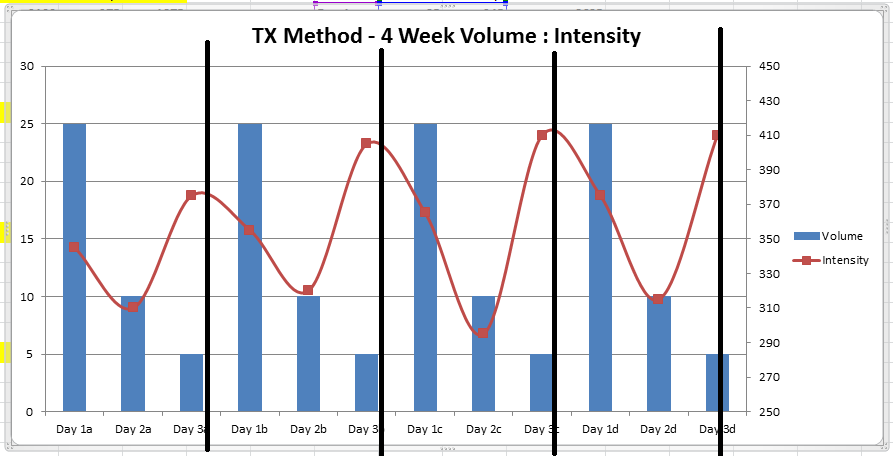
4 Week Volume/Intensity Relationship - Squat
           So here is the exact depiction of my last 4 weeks of training for one lift. 3 times a week as indicated on the x-axis by Day 1a (Week 1, Day 1) Day 1b (Week 2, Day 1) etc. You'll hopefully be able to figure out that the highest intensities (Right Y-Axis) occur on Day 3 each week, and that they successively get higher each week. The blue bars and corresponding Left Y-Axis simply illustrate the rep volume for the squat each day (Day 1: 5x5, Day 2: 2x5, Day 3: 1x5.) So as I alluded to in the last paragraph, there is a supercompensation cycle occurring after each Day 3, as well as before.


          So here is the exact same graph, divided by the scientifically implemented (MS Paint) black bars to separate each cycle of supercompensation. You'll effectively see the same 5 points brought up in the theoretical graph in this article as they pertain to this real life application. 

          To further illustrate this on a more holistic chart, I've created a line using values that are a product of both volume and intensity. It is included below.


** The inclusion of volume in the values skewed the chart causing the supercomp effect to appear on the first day of each week. In this case, the cycle still occurs regularly, but in a different regard. 


          Finally, this last chart is divided into cycles, similarly to the one above. Because the volume heavily skewed the total values, I've divided it on the first days of each week.

          Just a few more ideas using the visual representations to help illustrate a point. Will likely be using more of these in the next few posts as I find them really useful.

-Alex 


Sunday, October 14, 2012

Post 31: Loading Paradigm Analysis

          Loading paradigm analysis is neither as confusing nor as scientific as it sounds. In Periodization, Bompa and Haff present some different theories and manners of progressing loading. Linear, Step, and Flat loading are three different paradigms discussed in the chapter, but there are as many as may be permitted by your stupid little imagination. Before this starts sounding too much like a lit review, I'll cut to the chase. How does this help me get stronger?

         The book gives some simple graphs to illustrate the progressions mentioned before, and this got me to thinking; what would my own programming look like on a graph? Well to be frank, it wasn't exactly as I'd imagined. I decided to use volume in the traditional sense (sets x reps x weight) and compare those over weekly intervals in four week waves. To show a couple of the different paradigms in the book I've attempted to recreate them visually.

Linear Progression - 4 weeks

          Linear loading, or progression is most commonly observed with beginning or novice lifters who essentially make progress every time they get under the bar. According to Rippetoe, this occurs primarily because they make gains during each workout through either increased efficiency (larger gains) or purely improved strength (smaller gains.) As the individual begins to experience smaller gains and performance begins to taper, more complex loading patterns or programming needs to be considered. This type of loading may also be used in programming for experienced lifters too - as will be shown next - with the loading manipulations expressed as percentages of current and new PR's.   

Step Loading - 4 weeks (3:1)
          This is an example of step loading. As mentioned in the end of the last paragraph, sometimes linear style progressions can be used during advanced programming. This example includes a three week linear loading progression with deload or restitution period during the fourth week. If for example, this particular loading paradigm were using loads at 90%, 95%, and a new PR attempt - 100%+ - at the third week, a deload week would be warranted for the fourth due to potential for overtraining. Bompa & Haff recommend this style of loading during an adaptation or prep period. 

*The 3:1 ratio refers to number of weeks progression to restitution.


Step Loading - 6 weeks (4:2)

          This is another example of step loading where the loading progressions are taken to a fourth week, which in some circumstances will merit an additional (2 weeks total) of restitution. This extended recovery period would be particularly important if it were during periods of particularly high on field volume, or if it were to fall near the end of a prep or accumulation phase. 


Flat Loading - 12 week (3:1)
          Flat Loading as illustrated above includes three week periods of the same intensity and a fourth week for deloading or restitution. The next three week period is also of consistent - higher than last - loading plus a deload. This is appropriate during a phase of accumulation as suggested by Bompa, or for strength sports, where new strength is developed and needs to be solidified. I think of it as a transition (though not appropriately named) period between preparatory and realization or peaking as it's also called.  
*The 3:1 ratio refers to number of weeks progression to restitution.


Undulating Loading - 12 week (3:1)
          Finally, here is what step loading over 12 weeks may look like. In this case, the three week loading progressions heighten in intensity each of the three weeks followed by a restitution period as we saw in standard linear or step loading. The next period however, increases the loading parameters proportionately to the first week so that each third week is more intense than the last. The restitution periods also increase proportionately to resist any potential performance decreses during those times. 

*This may also be done using flat loading or a 4:2 paradigm.

Other Considerations for Deloading Weeks

          Deloading weeks may also serve a greater purpose than just business as usual using lighter loads. Some useful concentrations for these weeks may be a greater focus on speed work to increase ROFD as popular in the conjugate method. Another use may be to concentrate on a greater amount of assistance type exercises to strengthen synergistic muscle groups. 

          Anyways, there is a quick rundown on some different loading schemes and suggestions for deloading weeks. I like the graphs for providing visual representation of progress and (if I don't get distracted) I will try next time to include some more graphs that illustrate comparison between standard strength volume and volume of special exercises. 

-Alex


Wednesday, October 3, 2012

Post 30: The Most Important Coaching Tool

          I remember in my days of college athletics being in the training room and seeing a sign in the "Doc's" office that said: "Your athletes will never care how much you know, until they know how much you care." This holds true on the training floor as well. Athletes are not (always) stupid people, and are usually good judges of character. Since they are subject to instruction and forced to follow diligent schedules all day every day (by their own sport coaches) they only really respond to people who are fighting for the same cause as they are. If you come across as a coach without any compassion for your athletes, I assure you they will not hesitate to show great and immediate contempt for your efforts. After all, they are trusting their success to you, and in this position - your credibility is always (read: before you even open your mouth) at stake.

          This means things as simple as appearance and conduct are going to comprise your apparent amount of commitment to them AND their well-being, particularly when dealing with athletes opposite your gender. High-caliber athletes tend to be very skeptical by nature. They've heard it all and they've developed preferences and proactive inhibitions accordingly. They're like that girlfriend who (thinks she) knows exactly what she wants based on her previous boyfriends (in this case: coaches) and will respond best if you keep your mouth shut until you get a feel for her. Let your athletes do the talking at first, and learn to mold yourself into what they want - there will be plenty of time for YOU to open your big stupid mouth later.

I'd like to modify Doc's sentimental quote above into: "Your athletes will never care how much you know, until they know how much you know."


         In this case, I'm talking about coaching cues. Be direct, specific, and confident. No competitive athlete will respond positively to cues that start with: "Well it's kinda like.." "Maybe try to.." "I wonder if.." NO. You have one chance to earn their trust, and if you blow that, it's like leaving the cages open at the zoo. If you don't know what I mean, you were either born an amazing coach - or you work with chess players.


          Coaching cues are an art form in themselves. Like I said before, your knowledge is useless unless you can effectively convey your idea to your athletes. You have to keep your cues personal too, nothing drives a point home like when you can make it especially pertinent to a specific population. Make them feel special. I don't mean give them candy - I mean identify with each team, and as you progress, develop relationships with each individual athlete. If you simply don't have knowledge of the sport (basis for identification) then ask them before or after training about how their last tournament or game went, find out what they see when they compete. This will give you an insider's perspective, as well as help them recognize your personal investment in them. If you get really clever, you can start to develop cues that change their attentional focus while actually correcting 2 or 3 things inadvertently. Cueing them to concentrate on a spot 20 feet away on the ground while squatting can cause immediate neutral head position and better thoracic extension. This is particularly important when you work with large groups or teams, and need to make the most efficient use of your time and efforts.

          Sometimes the most effective answer (when applicable) is "I don't know." This doesn't work if the question is simple, and you're just a numb skull though. Athletes are crafty, and they will test you. But, if it's a serious question and a little bit outside your scope of knowledge, tell them you honestly don't know the answer BUT - and here's the catch - you will do everything you can to find out for them. This not only demonstrates your commitment to them, but also your ability to dig up information that they haven't been able to find on their own.

          Keep your cues as short as possible - sharp, mono-syllabic words are most effective with athletes. They like direction and structure. "Chest Up" "Butt Down" "Tight Core" things like that meet all three of our criteria. Beyond that, some one-on-one instruction once you get everyone else started can be effective if required, but remember. Make the experience special for them. Personal interaction in a bustling environment is one of many ways to establish a demonstration of their importance to you, and your personal investment in them.

-Alex

Monday, October 1, 2012

Post 29: Recent Interview With SweatRX

          I was recently contacted by a fellow S&C junkie at my gym who writes for SweatRX Magazine. In the past we had discussed some partway completed success stories, found that we read a lot of the same publications, and generally just hit it off. He had expressed some interest in doing an interview with me basically just to cultivate some fresh ideas on injuries and repetitive movement patterns. Naturally, I was excited to field some questions from a fresh (and informed) mind and recently, it came to fruition.


          Without any further information as to release or publication dates, I decided to take a few minutes to publish the questions posed as well as my answers here on the blog. Hopefully this will be of some use to you! Yes, I am aware that SweatRX is a "Crossfit Publication" but the guy who did the interview is a good dude, and the nature of the questions were not about the C-word. (Plus, this magazine has babes.)

SRX:  How common is it for high-level or pro athletes in traditional sports to sustain injuries?

GDS:  As long as there are sports, there will be injuries. Of immediate importance is to establish a distinction between two types of injuries in broad focus; those that can, and those that can’t be avoided. Inherently in collision sports like football and hockey, athletes are subject to high impact from other players. The prevalence of this is only exacerbated on the professional stage in cases like the Saints bounty scandal, nevertheless the risk exists in any circumstance during collision sport. The ones I’m referring to here are called contact injuries. Implicit in the name is the idea that these injuries are acute in nature and involve contribution of an auxiliary component. The second variety of injury we see are non-contact, or perhaps more appropriately, preventable injuries. These are of interest to whoever may be in charge of Strength & Conditioning. An athlete with unsound, compensatory, or inefficient movement patterns, lack of adequate range of motion about joints, short (tight) or long (loose) muscles in the wrong places or structural imbalances are (among others) potential constituents of non-contact injury. Of course, the number one job of the S&C coach is to keep athletes healthy and prepared for competition. My first mentor in this business used to say “prehab is for winners, rehab is for losers.” Suffice to say that your athletes should always be training with proper technique and progression to avoid or at least buffer the occurrence of these.

SRX:  What kind of repetitive movement patterns lead to injury for athletes?

GDS:  In my experience (and within the scope of this article,) repetitive movement patterns that contribute to injury may be credited to inconsideration of on-field volume, and/or simple misunderstanding of human kinetics. Things as simple as arm “prehab” for overhead athletes can increase likelihood of overuse injury. Exercises like resisted internal/external rotations should always be programmed and prescribed with special consideration given to practice/competition volume of the very same movements. Believe it or not, the effects of both training and practice volumes compound over the weeks and months of the training cycles. From another perspective, I wrote on my blog earlier this year about oblique strains in rotational sports, and how ineffective core training may in fact contribute to the occurrence of this problem. Performing resisted rotation (instead of resistance to rotation) trains the core musculature to function in a way that is actually the polar opposite of its natural purpose. Things like Russian twists etc. train the core to rotate between the hips and/or shoulders. In sport however, it is actually the shoulders and hips which provide the ballistic movement, and we need the core to resist this rotation in order to effectively maintain a neutral (read: healthy) spine. In this case, it becomes clear that a core trained to rotate, trying to perform its natural function of protecting the spine, would be less than ideal - especially when these types of exercises have been laughably categorized as “sport-specific.”

SRX:  How important is it for athletes to train beyond sport-specific movement patterns (e.g., incorporating basic strength movements) to shore up their general strength and functionality?

GDS:  Basic strength movements (in my opinion) should be a staple in all programming. Now let me validate this by saying that not every athlete should bench press, deadlift, and squat, but at very least variations of these should be included. Although there are safe(r) ways to do all of these –swiss bar benching, trap bar deadlifting, safety or cambered bar squatting etc. – other means are also reliable for producing desirable training effects. Unilateral (or single leg) work comes to mind when talking about building strength – and this is hardly what many would think of first when considering “basic strength movements.” During MOST athletic movement, general strength is characterized by the ability to perform in compromised positions and single leg work can be the answer (or solution, as per Mike Robertson’s Single Leg Solution.) Developing strong movement patterns in all planes using unilateral exercises (with proper form) is a great way to enhance functionality in terms of creating more efficient movement, better joint mobility, and can be done with less compressive loading. All of these benefits will nicely set the stage for any of the other aforementioned basic strength movements. Multi-planar lunges are great for developing well rounded single leg strength, with the added benefit of working deceleration into the mix. Things like glute-hams or single leg RDL’s with a yielding eccentric component also develop strong deceleration, and this is critical for maintaining knee health particularly for athletes who rely on varying degrees of positional agility in competition.

          So that's it for the interview, yes - I said it would be brief and I followed through on my promise so for that you are welcome. The only thing I may have changed would be to include some chatter about kettlebell work on the third question. I love the idea of having an athlete work to accommodate an implement like that (see more on this in Post 24: My What & Why of Movement Training) because as athletes, we know in competition that we rarely dictate the environment, and ability to adapt, is ability to succeed and survive!

-Alex